
Florence Sipalla
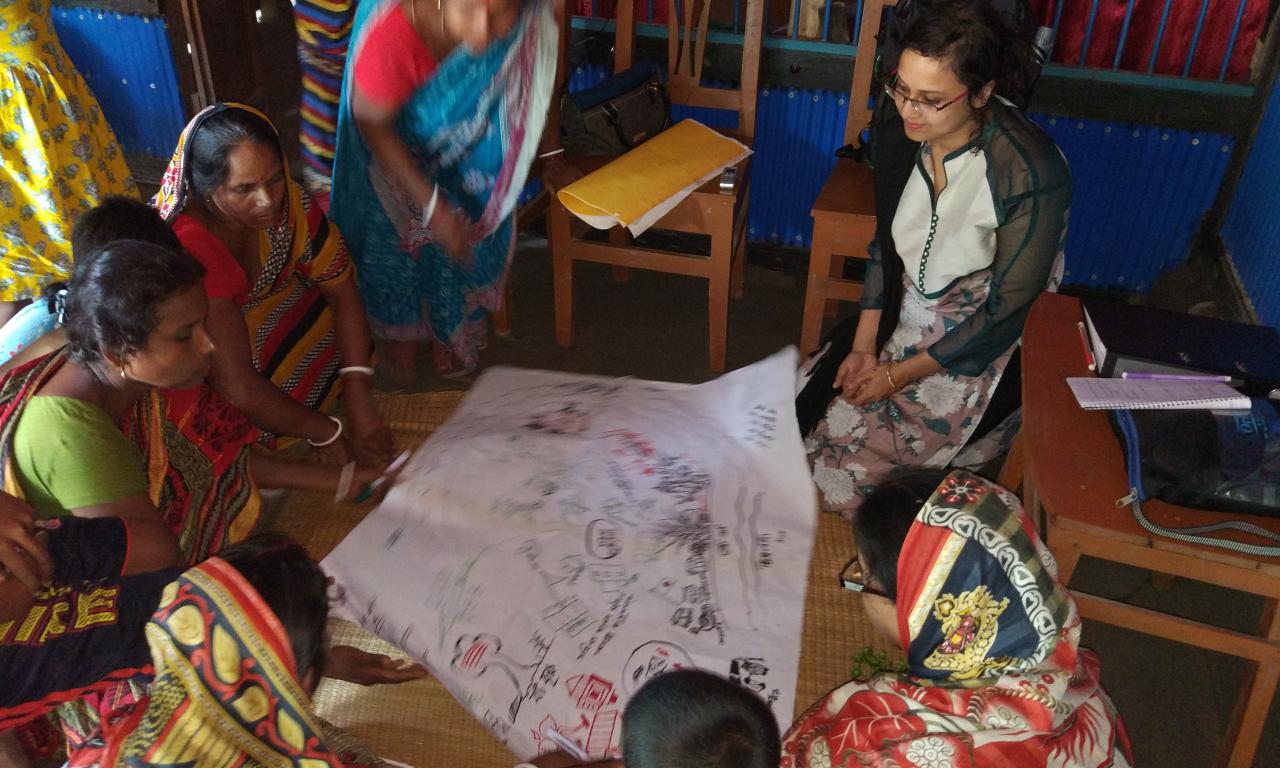
A new study examines how targeted support for women entrepreneurs can help to address gender inequality in aquaculture in Bangladesh. The research, led by Afrina Choudhury and conducted under the Gates-funded IDEA project (2018–2022), implemented by WorldFish in Bangladesh and Nigeria, applies a Multi-Level Perspective to explore how women’s “niche” level initiatives can challenge patriarchal structures in a bid to advance gender equity.
The researchers address a key knowledge gap: whether inclusive business models and strategies aimed at encouraging women’s participation in aquaculture businesses can trigger changes at a systemic level. To explore this, the study examines women’s entrepreneurial niche development in aquaculture, explores the key constraints women entrepreneurs face, and explores ways to address them to ensure change at different levels of society.
A central insight from the study is that women in aquaculture were already innovating long before development projects arrived. Instead of designing interventions from the top down, the program built its niche-level initiatives around these existing forms of agency. The program focused on creating “niche spaces” where women could safely experiment, learn, and build businesses.
The study also highlights the importance of institutional level strategies. WorldFish researchers note that ensuring aquaculture businesses are registered and licensed in women’s names contributes to shifting gears towards gender equality. The study also notes that having bank accounts allowed women to take charge of money earned through their entrepreneurial work, thus translating to empowerment.
Furthermore, alignment between entrepreneurial efforts by women, government policies and action plans provided an opportunity to create an enabling environment that could amplify women’s benefits. The researchers also recognized the role of male involvement in reshaping gender norms. For example, involving male spouses in capacity building workshops led to some men seeing value in providing support in care work on the domestic front and allowing women to take over handling of the businesses closer to their homes or at the farm gate.
Thus, it is important to work with both men and women as change agents in the community to support and advance entrepreneurship among women. When women’s entrepreneurship is supported through training, business registration, policy alignment, and social norm change, these niches can begin to challenge the wider aquaculture regime, which has historically been shaped by male-dominated spaces, unequal access to technologies, and restrictive social norms.
Why This Research Matters
According to the International Finance Corporation (IFC), in Bangladesh, women only own 7.2% of the country’s 8 million businesses. They mainly work in small businesses and some even lack licenses for their businesses. Even when women are involved in businesses in the aquaculture field, they rarely get recognition for their contributions. Owing to patriarchal socio-cultural norms, policy and local contexts, women are mainly involved in the businesses at household level where they also juggle care responsibilities. Women are involved across the aquaculture value chain, often in undervalued invisible roles, such as market sales, which are largely male-dominated. As a result, they hardly get visibility or financial benefits for their contributions.
Bangladesh is a signatory to international instruments such as the Convention on the Elimination of All Forms of Discrimination against Women (CEDAW) and Sustainable Development Goals, where goal 5 is geared towards gender equality. The researchers note that governance strategies, coupled with community engagement have the potential to challenge dominant aquaculture regimes and advance women’s entrepreneurship.
Read the full publication: Shifting the aquaculture regime toward gender equity? Case studies of women’s entrepreneurial niche innovations in Bangladesh
Cover photo: A focus group discussion with women aquaculture entrepreneurs in rural Bangladesh, facilitated as part of gender equity research. Photo: Sarah Sultana.