
Menna Mosbah

Rajita Majumdar
Ahmed Nasr-Allah Mohamed
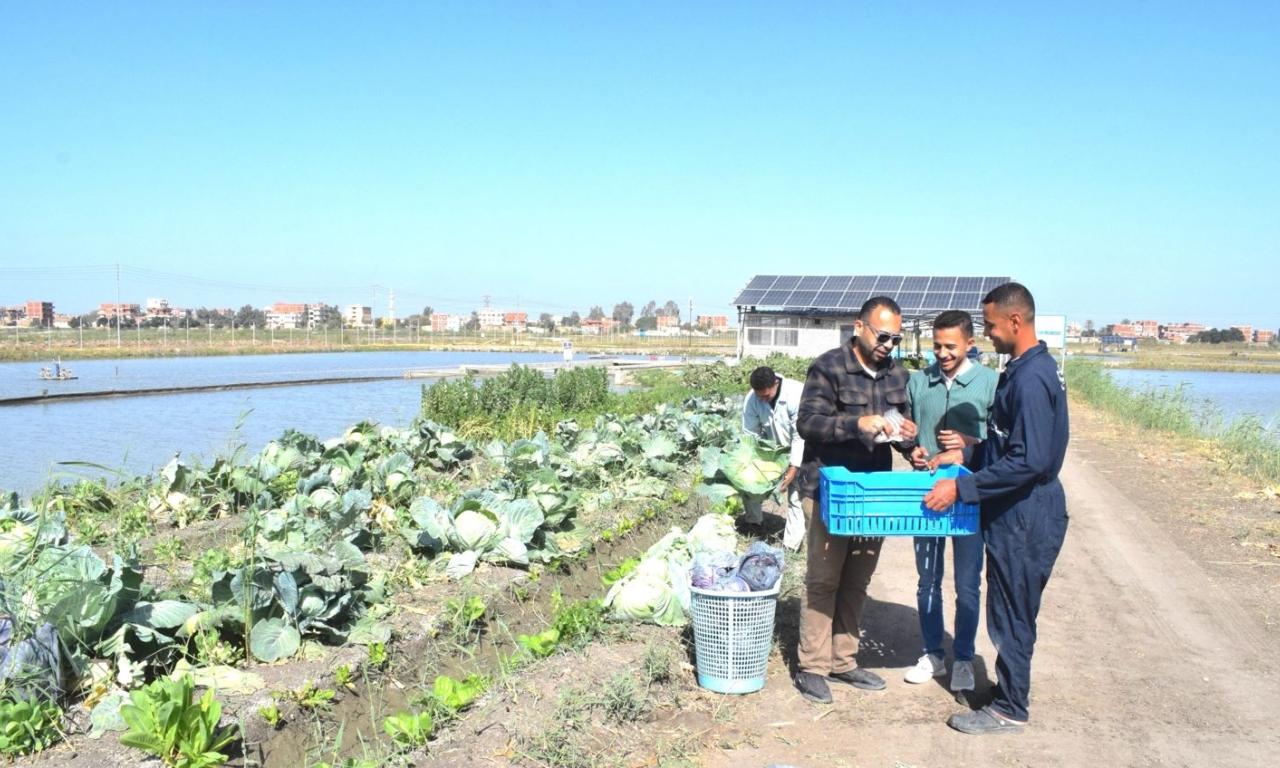
New research from Abbassa examines the link between raceway design, water reuse efficiency and dual food productivity for a more sustainable food future in arid regions.
As pressures on water and land intensify in Egypt and across arid regions, the question for aquaculture is no longer just how to produce more fish, but how to produce more while optimizing environmental resource inputs. The challenge is to innovate systems that do not just conserve water but can reuse or recycle every drop and every nutrient.
At WorldFish’s Abbassa Research Center in Egypt, scientists are testing a futuristic model: In-Pond Raceway System (IPRS) aquaculture integrated with organic crop production. In its latest research, a team of scientists experimented with system design – playing around with the physical geometry of an IPRS or raceway pond to optimize benefits for fish health, crop yield and overall water efficiency.
The research aims to model a scaling technology for Integrated Agriculture-Aquaculture (IAA) systems in Egypt. Supported under CGIAR Scaling for Impact (S4I) science program, IAA systems are sought as a promising pathway to increasing farmers’ productivity in arid lands where water salinity and limited environmental resources pose major challenges to feed and nourish a growing population.
Raceway Ponds: Designing to Drive Performance
The raceway pond is a paradigm shift – instead of the fish being dispersed throughout a large pond, they are concentrated in river-like controlled, water flow within it. This creates a point source of nutrient-rich effluent and allows for 100% water reuse and precise management of water quality and waste, allowing for maximizing IAA potential for resource efficiency. The experiment specifically investigated how raceway cell size affects Nile tilapia performance, water quality and crop success – key factors for scaling sustainable aquaculture and IAA practices.
The team established two experimental pond models stocked with the high-performing Abbassa Nile tilapia at identical commercial stocking densities to isolate raceway geometry as the key variable. By holding fish density constant, the experiment focused on how the shape and flow dynamics of the raceway itself can become the engine of system performance.
The Near Net-Zero Fish-Crop Farming integration
The true gain of the IAA system lies in its closed-loop cycle logic:
- Fish produce nutrients. In the raceway systems, fish metabolize feed, releasing ammonia and solids in their effluent.
- Waste is segregated. This water flows to a settlement reservoir. Solids settle out for potential use as compost.
- Nutrients become fertilizer. The clarified, nutrient-rich water—high in crop-benefiting nitrogen but toxic to fish at high levels—is diverted to irrigate eight types of organic crops: lettuce, cauliflower, eggplant, pepper, cabbage, onion, Vicia faba, planted across 0.13 acre (1/8 feddan).
- Water is recycled. Simultaneously, filtered water from the top of the reservoir is recirculated back to the pond, reducing the need for fresh water replacement.
The raceway pond creates a double-win – it purifies the water for the fish by removing metabolites while providing free, organic fertilizer for crops, moving the system toward zero-water-consumption.
Early results indicate that raceway design is far from an abstract engineering detail. It can be the hydraulic heart that pumps efficiency through the entire integrated fish-crop system.
“Early observations suggest that raceway geometry significantly influences hydraulic efficiency and waste removal. The cell with optimized flow dynamics appears to maintain more stable dissolved oxygen levels and better water quality,” said Haytham Abd El-Ghaffar, Scientist, WorldFish, Egypt.
These gains have direct, cascading effects on productivity of the system:
- For the fish: Stable oxygen lowers physiological stress (confirmed by blood biomarker analysis) and improves feed conversion ratios, boosting growth and health.
- For the farmer: Better hydraulic efficiency reduces the energy required for aeration, a major operational cost.
- For the crops: A steadier, higher-quality nutrient stream in the irrigation water translates to more robust vegetable growth and yield.

Next Phase: Evidence and Economics for Scaling
The evidence-based design specifications from final analysis of the experiment will inform the optimal raceway configuration under Egyptian conditions, opening a pathway to scaling fish-crop systems harnessing raceway pond design for maximum resource efficiency.
In the next phase, implemented through the S4I initiative, WorldFish will work with partners on practical scaling of similar IAA models in arid areas of Egypt through three interconnected actions:
1) Precise economic modeling to quantify the dual-income potential from fish and organic vegetables against costs;
2) Farmer-led piloting to test the optimized design and refine management protocols with partners; and
3) Formal resource audits to document water savings and nutrient-use efficiency, building a compelling case for private sector and investors.
“The integrated raceway pond fish-crop trial in Abbassa demonstrates how strong experimental evidence can guide the design of scalable integrated agriculture-aquaculture models for arid regions. The optimized raceway pond design emerging from this experiment opens a significant scalable pathway and strategic partnerships for improving water efficiency and farmer incomes with our partners in Egypt and similar arid regions,” said Khondker Murshed-e-Jahan, Scientist, WorldFish, Bangladesh.
*This research adheres to strict animal welfare standards under IACUC Protocol ARC/CLAR/50/25 and contributes to the CGIAR Scaling for Impact’s mission of delivering sustainable aquaculture solutions*.
Cover image: Integrated Agriculture-Aquaculture in In-Pond Raceway System (IPRS) at WorldFish’s Abbassa Research Center, Sharqia. Photo: Haytham Abd El Ghaffar, WorldFish Egypt.