
Eunice Ayo-Aderele
A new digital feed formulation tool is at the center of the Development and Scaling of Sustainable Feeds for Resilient Aquatic Food Systems in Sub-Saharan Africa (FASA) project’s final phase, translating years of research into something farmers, feed producers, and extension systems can use in real time, supporting better feed decisions and helping address cost, quality, and access challenges.
This direction shaped discussions when FASA, supported by the Norwegian Agency for Development Cooperation (Norad), held its inaugural monthly coordination meeting, bringing together key project partners from WorldFish, CORAF, IITA, the International Centre of Insect Physiology and Ecology (ICIPE), and the Swedish University of Agricultural Sciences (SLU). The meeting marked a significant step in the project's commitment to stronger cross-partner collaboration.
From Research to Scalable Application
The recently approved project redesign sharpened FASA's focus on delivering a scalable, digitally-driven feed formulation application. Rather than committing to improved raw materials within the project's remaining timeline, the project now focuses on building and scaling a digital feed formulation tool — a decision that positions FASA's outcomes for broader, longer-lasting reach.
Funding has been secured for PhD students to complete their studies through Q4 2028. Norad has also approved support for two major regional workshops as well as the development of feed training videos for use on farms across the project countries.
Research Progress Across Partner Institutions
With 18 months remaining, Project Coordinator and Senior Scientist (Bioscience), Dr. Matthew Owen, opened the meeting by setting expectations for the final phase. The monthly meetings are designed to strengthen coordination and strategic alignment across partners, ensuring every team has clear visibility on what has been delivered, what remains, and where adjustments are needed in real time.
Partners presented encouraging updates from the field and laboratory. At WorldFish's hub in Malaysia, six digestibility trials have now been completed, with sample analysis underway. An external developer has been brought on board to begin building the backend of the feed formulation app, a milestone that signals the transition from research to tangible digital product.
In Zambia, WorldFish's Mary Lundeba reported that a protein requirement experiment for two tilapia strains (one improved, one non-improved) is set to commence in the third week of March, with feed formulations already completed and fingerlings sourced. Two blog posts have been developed and submitted to communications, including one published the day of the meeting covering a recent gender training with partners. Preparations are also underway for on-farm trials, with farmer identification planned for later in the year.
From Kenya, Dr. Chrysantus Tanga of ICIPE reported that five experimental trials on nutrient requirements for catfish and tilapia have been completed, with post-experimental analysis ongoing. Crucially, protocols for two on-farm trials have been developed, a farmer has agreed to make their pond available for the duration of the feeding trials, and the team expects to initiate on-farm work in April, with data collection targeted for completion by year's end. Five manuscripts have already been published from the Kenya team's work, with six more submitted for internal review.
At SLU in Sweden, Dr. Kartik Baruah and the PhD research team shared progress on ingredient improvement techniques, including physical processing, solid-state fermentation, and soaking with probiotics. A master's student has been engaged to explore how existing fermentation and pre-treatment approaches can further enhance nutrient profiles of locally available ingredients. Feed formulation work is also progressing, with the team targeting completion of all improvement-related work by the end of 2026, followed by lab trials and eventual on-farm validation.
In Nigeria, CORAF is on track to complete all nutrient requirement studies for both tilapia and catfish by the end of 2026, covering vitamins C and phosphorus. The team is also planning PhD student validation studies and on-farm pilots in coordination with SLU, with timelines being carefully synchronized across partners.
Scaling the Digital Solution: A Country-Led Approach
Attention is now turning to how the feed formulation tool will be scaled across countries. Dr. Murat Sartas of IITA presented a clear roadmap for 2026, emphasizing that scaling success will be owned and led by country teams. The plan involves developing an overarching scaling strategy by mid-April, followed by country-specific action plans that account for local contexts, partnerships, and user needs.
To support this, each country team will nominate a dedicated scaling contact point to facilitate daily interactions with the development and scaling team. Real-time tracking of how, when, and where the app is being used will be built into the platform, with a live dashboard to monitor uptake and guide decisions. A multi-stakeholder engagement event in each country is planned for the final quarter of the year, bringing together academia, industry, and government to ensure the digital solution is embedded within the broader feed ecosystem.
Communications: Telling the Story of FASA's Impact
WorldFish Communications Coordinator outlined ongoing and planned communications efforts to ensure FASA’s work reaches beyond academic audiences to farmers, policymakers, investors and the wider aquaculture community across Sub-Saharan Africa.
As the project shifts toward delivery, communications will focus on how the tool is used in practice and where it is gaining traction.
FASA is also targeting a significant presence at the AFRAC conference in Tanzania in December 2026, including a proposed roundtable on aquaculture feed in Africa convening voices from academia, government, and industry.
Positioning for Lasting Impact
As FASA enters its final phase, the focus is increasingly on delivery, uptake and scale. Work across research, digital tool development and on-farm validation is being coordinated toward practical outcomes.
The project’s redesigned focus ensures that what is delivered is usable, scalable and grounded in the realities of fish farmers across Nigeria, Zambia and Kenya.
The feed formulation tool provides a pathway to extend the project’s impact beyond its timeline, translating research into knowledge and systems that will continue to strengthen aquaculture food systems across Sub-Saharan Africa for years to come.
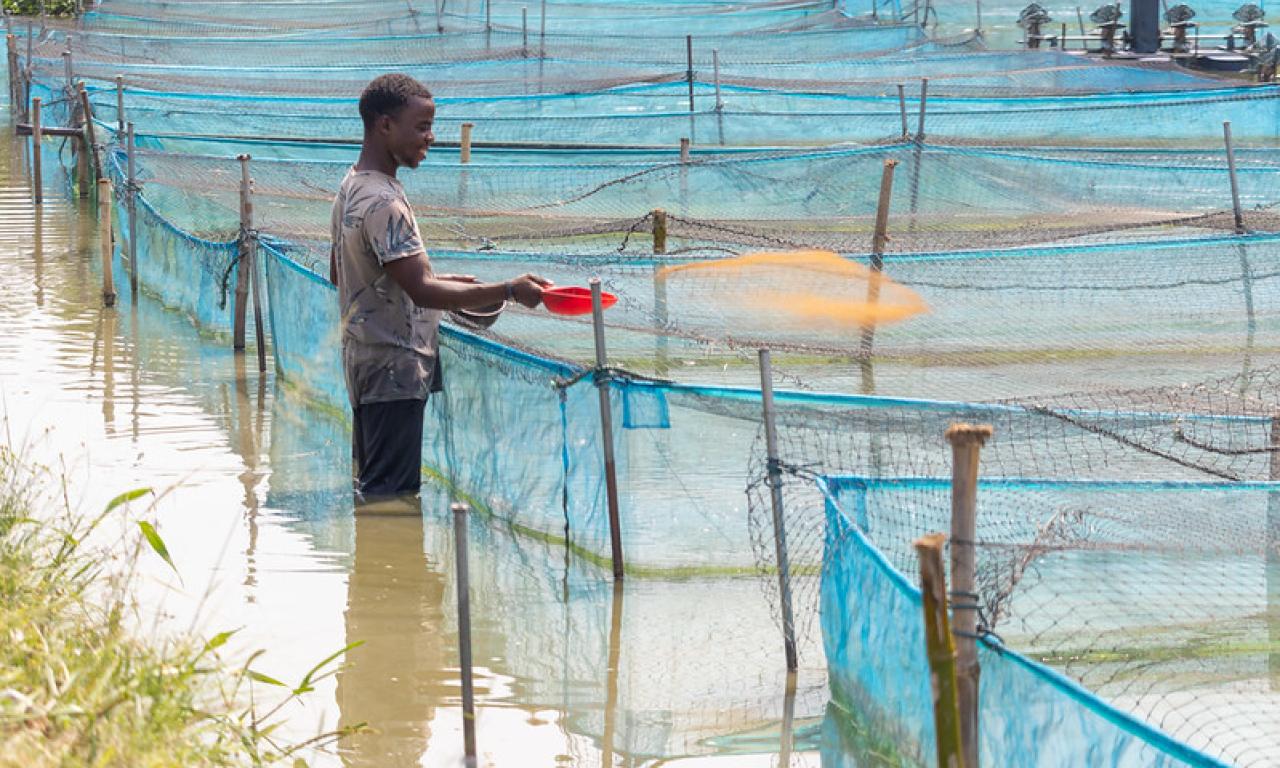
Cover photo: Feeding fish on a commercial farm in Nigeria, where feed decisions shape costs, growth, and farm performance. Photo: Sam Shng Shng/WorldFish.