
Anthony Langat
Coastal ecosystems are under mounting pressure from a range of stressors. Conservation, restoration, and management actions are necessary to turn the tide, but they can disproportionately burden local people, whose stewardship is essential for long-term sustainability.
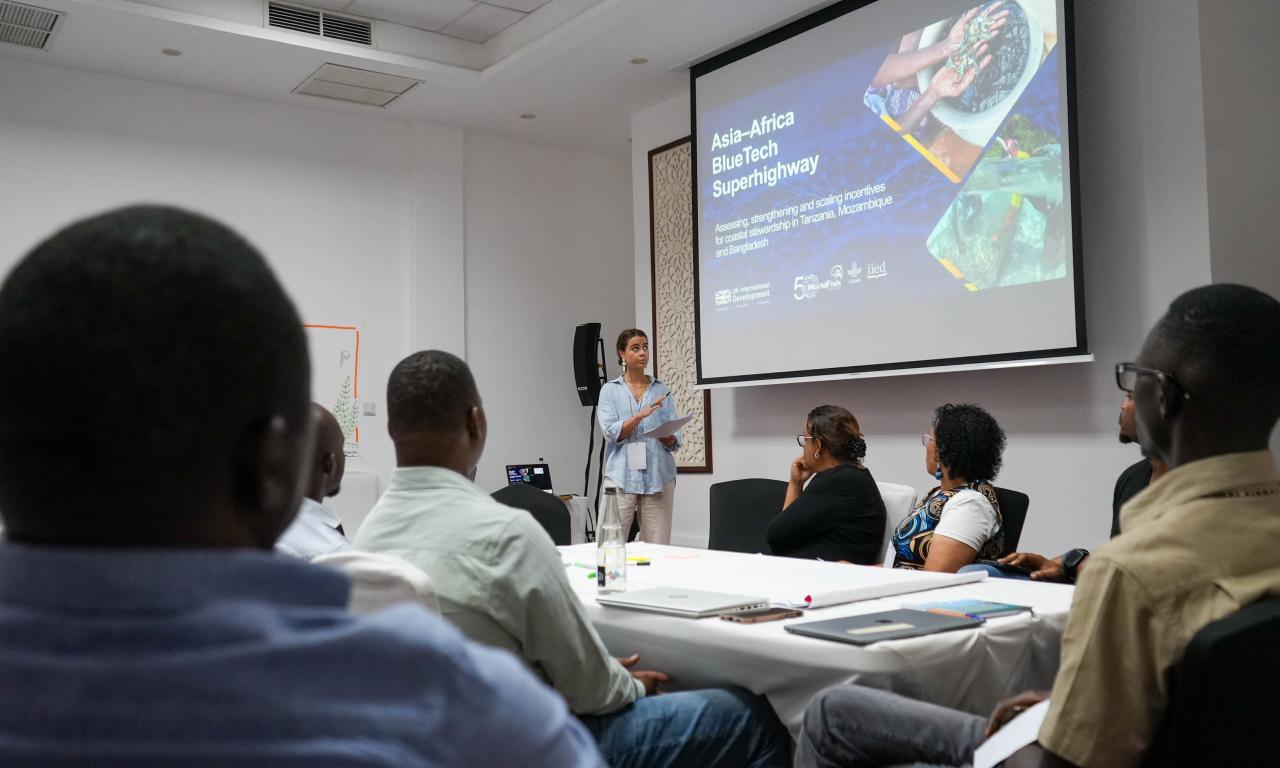
At the 13th WIOMSA (Western Indian Ocean Marine Science Association) Symposium in Mombasa, Kenya, the International Institute for Environment and Development (IIED), WorldFish and partners convened an interactive session on Strengthening coastal stewardship: from tools to action. The session explored the barriers and solutions to implementing practical tools - such as social protection, subsidies, market solutions and measures to secure tenure rights - that can enable and incentivize fair and effective coastal stewardship.
Laying the Groundwork: Why Incentives Matter for Coastal Stewardship
Following an introduction from IIED’s Annabelle Bladon, the session opened with Hyrene Emmanuel Kamulas, a coastal community leader from Tanzania, who shared her story of environmental stewardship and experience with Mwambao Coastal Community Network’s MKUBA eco-credit program. Her reflections set the tone for the session’s exploration of tools to strengthen coastal stewardship, focusing on positive economic incentives as a key approach.
This was followed by brief presentations sharing new findings from research conducted under the Asia–Africa BlueTech Superhighway (AABS) project in Tanzania and Mozambique, as well as relevant work from CORDIO in Kenya.

Evidence From the Field: What Incentive-Based Approaches Deliver
AABS consultant Manuel Castiano highlighted Mozambique’s strong legal foundations for incentive-based approaches and their broad application across the country, pointing to fisheries, environmental, and conservation laws that promote co-management and community benefit-sharing. Castiano presented preliminary results from the evaluation of a case study: an intervention designed to reduce fishing pressure by providing financial and technical assistance to establish a community poultry farming business. It was demonstrated that the project improved fisher livelihoods and reduced fishing pressure. However, limited funding and other challenges affected its sustainability. In order to ensure effective community engagement in coastal conservation activities, Castiano recommended that there is a need to streamline the approval of local management tools, resolve issues of access and use rights, and align incentives and expectations while treating communities as active partners.
Kokubanza Timanywa from Sustain East Africa presented findings from an evaluation of a case study in Songo Songo, Tanzania. In this intervention, the Songo Songo Beach Management Unit implemented a temporary reef closure to allow octopus stocks to replenish. The increased revenues resulting from higher octopus catch were distributed among stakeholders. After the three-month trial closure, fishers landed over 10,800 kg of octopus worth about USD 17,200. The intervention produced a number of positive environmental and economic outcomes for the community. However, the study highlighted the need to strengthen financial management, governance, and accountability systems.
Complementing the work of Sustain East Africa, Julius Francis of WIOMSA presented findings from a review of the institutional, legal, and policy frameworks for incentive-based approaches to coastal conservation and fisheries management in Zanzibar.
The study found that there are numerous institutions supporting coastal conservation, fisheries management, and social protection, all operating under various policy and legal frameworks. However, while social protection coverage remains low, it is increasingly reflected in fisheries-related legal frameworks, and numerous initiatives have been introduced to improve the livelihoods of fishers through access to fishing gear, boats, cold storage, credit, and training.
The final presentation on Understanding the Financing Contexts of Locally Managed Marine Areas to Promote Best Practices in Sustainable Finance, was delivered by Kennedy Oalo of CORDIO. Oalo identified constraints such as limited and unsustainable funding and low local awareness of marine financing opportunities.
He also noted fragmented coordination among funders, complex regulations that hinder access, and limited organizational capacity to manage funds. He added that equipment and infrastructure are not sufficient to carry out implementation of management activities.
Oalo’s study recommends the forging of partnerships between private stakeholders, NGOs and relevant actors, training to broaden financing sources, identification of diverse funding opportunities for conservation initiatives and developing of policy frameworks for internal revenue generation. The study also recommends encouraging sustainable fishing and tourism to boost revenue generation and building community ownership of the financing mechanisms.
From Insights to Action: Governance, Finance, and Capacity
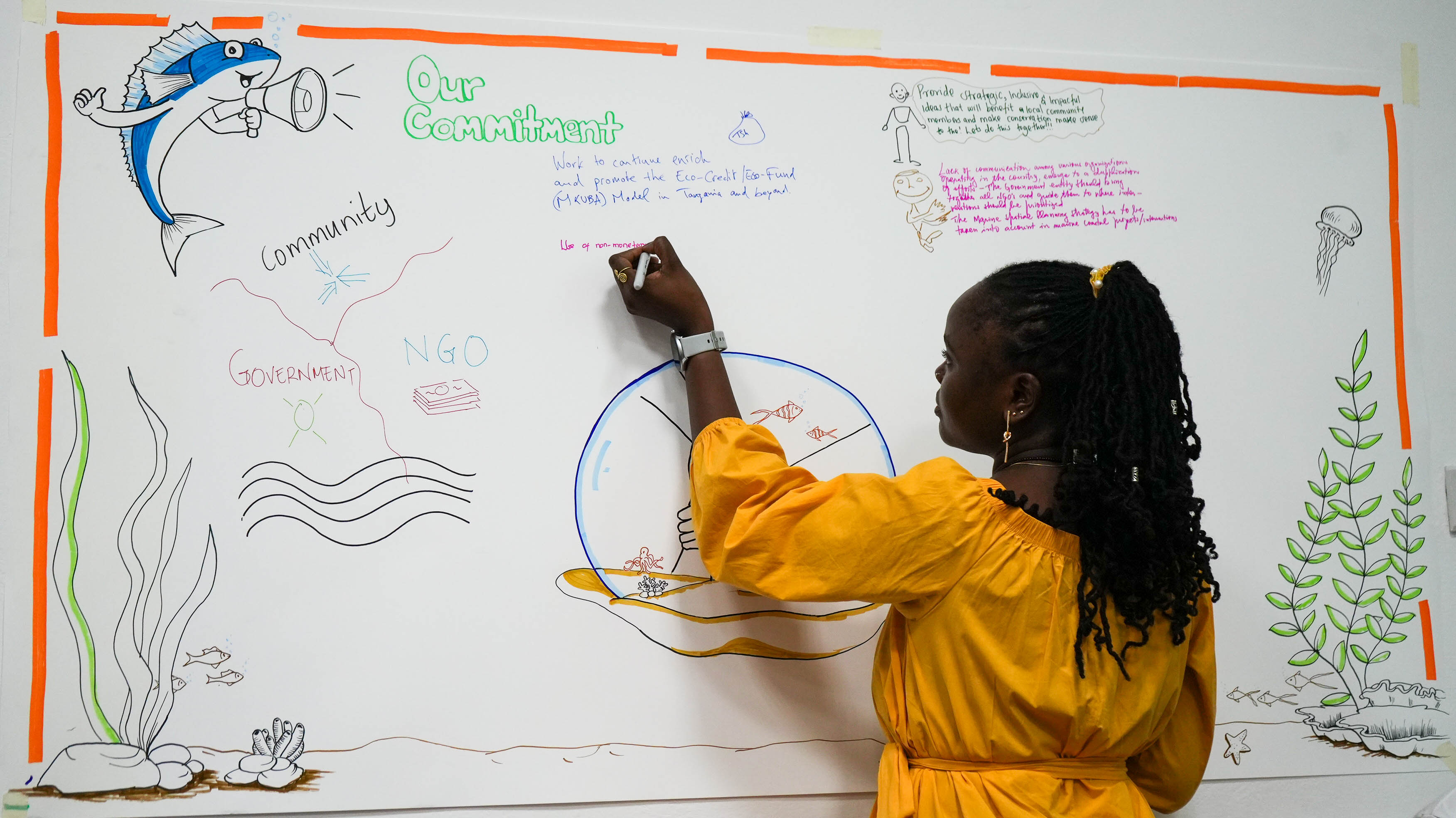
Following the presentations, participants took part in a World Café. They rotated around three stations, each focused on a key actor in enabling and incentivizing coastal stewardship:
- Government
- Coastal communities and community organizations, and
- NGOs. The groups then shared their insights in a plenary, leading to an open discussion on possible pathways forward.
The session arrived at recommendations on governance, finance and investment, implementation and capacity building. Participants emphasized the importance of collaboration among NGOs; stronger Monitoring, Evaluation, Learning and Adaptation systems; greater investment in capacity building, technical assistance and financial support for small-scale fisheries workers and their organizations; nutrition-sensitive fisheries policies; and leveraging the OECM framework to support and expand community-led management.
Strengthening coastal conservation and fisheries management across the Western Indian Ocean depends on communities being able to exercise their rights, access the resources they need, and draw on the support that enables them to steward their environments effectively and equitably. The session’s recommendations, now summarized in the official session report, highlight clear pathways forward to effectively support nature, livelihoods, and food and nutrition in the region.
Cover photo: IIED senior researcher, Annabelle Bladon, gives an introduction to incentives for coastal stewardship. Photo: Catherine Muyonga/IIED.