
Eunice Ayo-Aderele
Nigeria’s demand for fish is rising fast, but domestic production isn’t keeping pace. With a population exceeding 200 million and an annual fish demand of nearly four million metric tonnes, Nigeria faces a daunting reality: domestic production of 1.2 million tonnes of fish annually leaves a gap of over two million tonnes, costing Nigeria more than USD $1.2 billion in fish imports every year.
This imbalance underscores the urgency for transformative solutions that can secure food and nutritional security while driving economic growth.
At the recent 40th Fisheries Society of Nigeria (FISON) annual conference, held from 27th to 31st October 2025 at the School of Postgraduate Studies, Nasarawa State University, Keffi, WorldFish was a Platinum sponsor, and the spotlight was firmly on the future of aquatic food systems. The event brought together over 200 participants comprising researchers, policymakers, and industry players who gathered to explore how innovation and partnerships can unlock Nigeria’s blue economy...
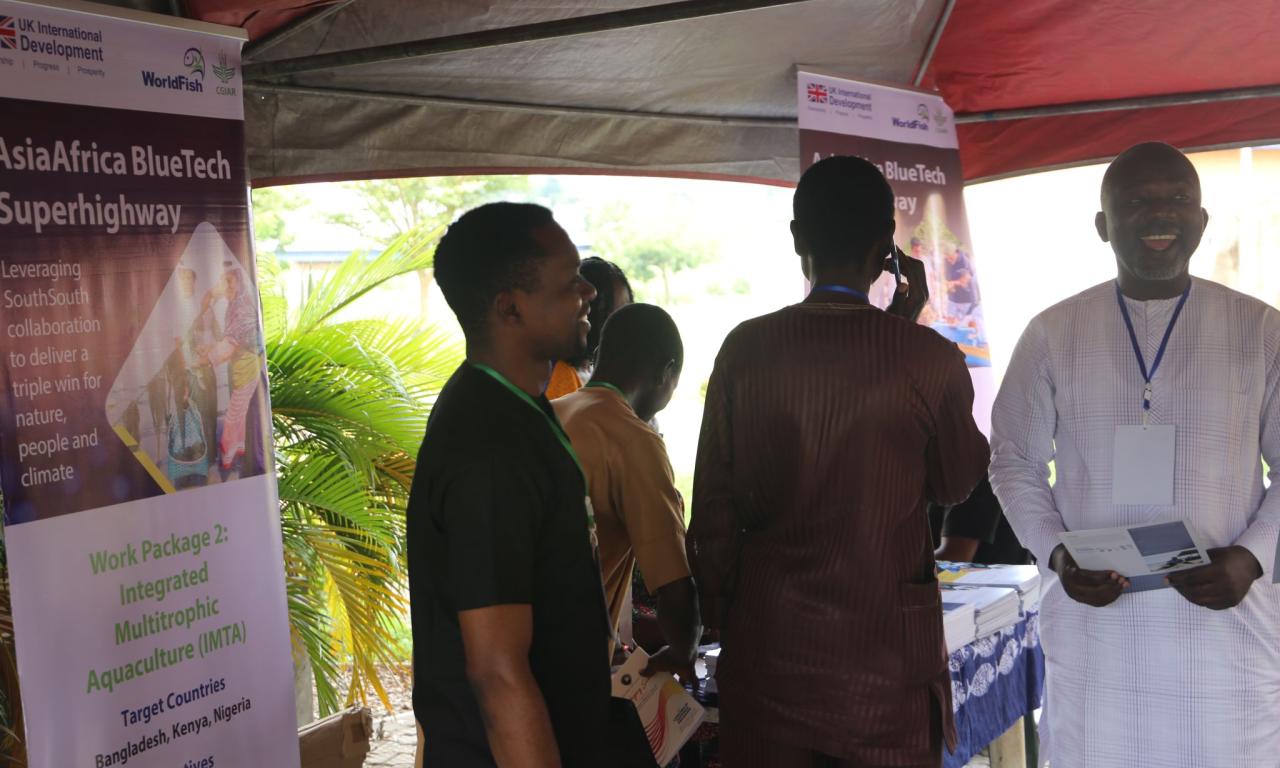
The Asia–Africa BlueTech Superhighway (AABS) project contributed to FISON conference participants’ knowledge of IMTA (Integrated Multi-Trophic Aquaculture).
Global Importance of Aquatic Foods
Country Representative of WorldFish Nigeria, Dr. Charles Iyangbe, captured the essence of this challenge during his plenary address titled Nigeria's Aquatic Food System: Partnerships for a Sustainable Future. He noted that “Nigeria’s fisheries and aquaculture sector is at a critical turning point. The challenges are significant, but the opportunities are greater, still.”
His words reflect a sector brimming with potential, yet constrained by systemic issues such as high feed costs, limited access to finance, and overreliance on catfish production.
Globally, aquatic foods are more than a source of protein; they are a lifeline for billions. They provide over 20 percent of animal protein for 3.3 billion people and support millions of jobs along the value chain. In Africa, fish accounts for up to 20 percent of animal protein intake, making aquaculture one of the fastest-growing food production sectors. Yet, Nigeria’s average fish consumption of 11.3 kilograms per person remains far below the global average of 21 kilograms.

Innovation for Sustainability (AABS-IMTA Initiative)
AABS Lead Scientist, Dr. Okomoda Victor Tosin, emphasized the global significance of aquatic foods during his technical session, noting that
“Aquatic foods can supply essential micronutrients with a lower carbon footprint and far fewer biodiversity impacts than many land-based crops and livestock.”
One of the most promising innovations for Nigeria is IMTA. As Dr. Okomoda explained,
"IMTA is the production of different aquaculture species of different trophic levels using the circular economy approach.”
Waste from one species becomes food for another, reducing pollution and creating multiple income streams. IMTA offers environmental sustainability, economic resilience, and climate-smart benefits.
This approach aligns perfectly with Nigeria’s need to diversify beyond catfish, which currently accounts for over 90 percent of aquaculture output. By integrating finfish, shellfish, and seaweed, IMTA can mitigate the risks of market saturation, improve water quality, and generate value-added products.
Driving this innovation is the AABS, a UK-funded initiative under the Blue Planet Fund. WorldFish is spearheading this project to transform aquatic food systems through South-South cooperation, scaling technologies across continents.
In Nigeria, AABS is piloting brackish-water IMTA systems in coastal states like Lagos, Ogun, and Ondo, deploying locally fabricated cage systems and training stakeholders.
Dr. Iyangbe highlighted the strategic importance of this initiative, stating that
“AABS is creating the scientific and practical foundation for scalable, climate-resilient aquaculture systems that can improve productivity and secure sustainable livelihoods across Nigeria’s blue economy.”
Building Farmer Capacity and Market Integration
Beyond technology, success in aquaculture depends on farmer capacity and market integration. WorldFish Post-Doctoral Fellow, Fasakin Idowu James, in his session on farm management and marketing, stressed the importance of record-keeping, biosecurity, and business planning.
“Keeping accurate production and financial records is essential for managing budgets, tracking profitability, and conducting financial analysis,” he explained.
Training programs under AABS and related projects equip farmers with skills in integrated farm management, water quality monitoring, and marketing strategies. From branding IMTA products as “sustainably farmed” to leveraging social media campaigns, these efforts aim to position Nigerian aquaculture competitively in local and export markets.
A Call for Collective Action
Despite progress, the sector faces persistent hurdles. High costs of feed and fingerlings, technology gaps among smallholders, post-harvest losses of up to 80 percent, and limited access to finance and secure land tenure remain significant barriers. Yet, as Dr. Iyangbe observed,
“Where many see challenges, WorldFish sees opportunities; but only if we embrace deep collaboration across stakeholders.”
His roadmap for transformation rests on scaling through local partnerships, generating evidence for policy and investment, localizing technologies, empowering communities, and embedding climate adaptation in production systems.
Nigeria’s aquaculture sector holds the potential to revolutionize food systems, create jobs, and strengthen resilience against climate change. But this transformation requires collective effort—policymakers, researchers, private investors, and farmer cooperatives must work together.
As Dr. Iyangbe concluded, “Let us not be content with being a major fish-importing nation. Let us set our sights higher to become Africa’s leader in aquaculture. This is not a dream; it is an achievable goal if we work together.”
Cover photo: FISON 2025 participants register at the AABS stand, engaging with WorldFish teams on integrated, climate-smart aquaculture solutions. Photo: Eunice Ayo-Aderele.